HEOR Strategy
Too many life science companies arrive at the point of health technology assessment (HTA) submission or payer engagement without a coherent evidence strategy.
Clinical studies may have been designed to satisfy regulators rather than payers, endpoints chosen simply for their clinical convenience and real-world evidence generated without the necessary methodological rigour. The consequences are predictable: weaker submissions, longer timelines and avoidable failures at precisely the moment when success matters most.
There is no recognised standard or framework for high-quality evidence generation. This course therefore consolidates the many different approaches to this fundamental task into a single structure spanning the product lifecycle from early development through HTA submission and beyond. Over eight modules, participants learn to specify evidence requirements from the decision landscape, map the existing evidence base, prioritise gaps using both value of information and deliberative methods, sequence clinical and economic studies against technological maturity, design for acceptance by named decision-makers, negotiate conditional access arrangements and govern the plan over time. Structural constraints specific to medical devices, diagnostics and digital health are addressed throughout and the course concludes with the construction of a complete evidence generation plan.
Delivered via HEOR Institute’s online learning platform and through live interactive virtual tutorials you will become part of a global community that is building compelling evidence for healthcare decision-makers.
On completion of this course you’ll be able to:
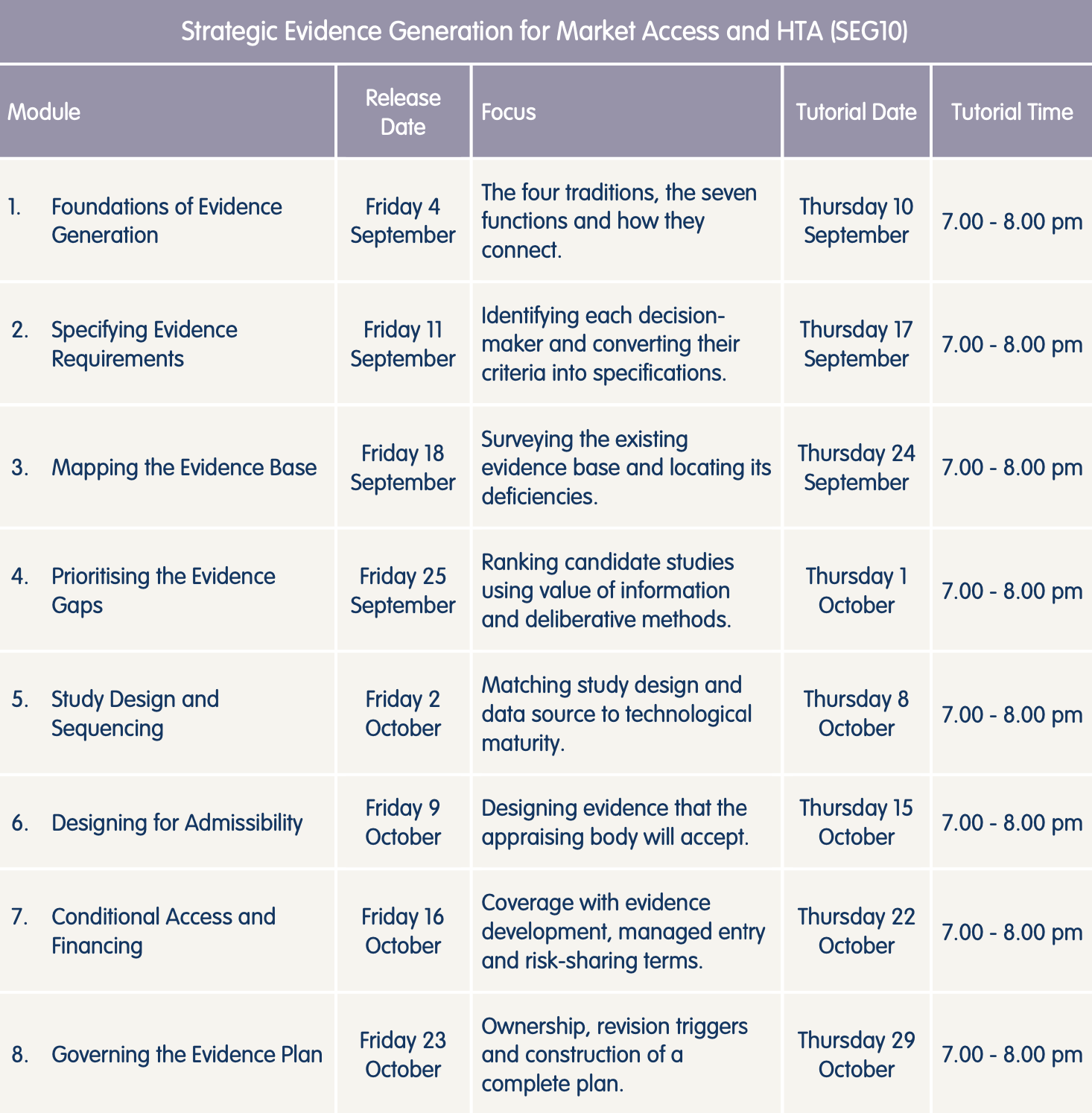
This course is broken down into eight manageable weekly modules:
This course should take approximately 3–4 hours per week. You can expect to devote about 1–2 hours per week to self-paced learning, about 1 hour per week preparing for and participating in the virtual tutorial and 1 hour per week applying your knowledge through learning activities and case studies. Every tutorial is recorded so you can rewatch it at any time.
This course is designed for market access professionals, medical affairs specialists, HEOR managers and commercial leaders in the life sciences and medtech industries who are responsible for planning or overseeing the evidence that supports reimbursement, HTA submissions and procurement decisions. It is equally relevant for clinical and regulatory affairs professionals aligning regulatory and HTA evidence requirements, and for consultants who advise on evidence strategy. The content of this course is applicable to drugs, medical devices, diagnostics and digital health with structural constraints specific to non-pharmaceuticals addressed throughout. No prior modelling experience is assumed: the course introduces value of information and evidence mapping methods from first principles. Participants will benefit from familiarity with HTA processes and the healthcare product lifecycle
Upon successful completion of the course you’ll receive a:
Ready to start? Just click the ‘Register now’ button at the top of this page or use the ‘Ask us a question’ button if you’d like to talk to one of our course facilitators. The fee for this course is £995 per person. If you’d like to pay in instalments you can arrange this by contacting us at: [email protected].
All registrations are subject to our terms and conditions which are available here. By registering for a HEOR Institute course you are accepting these terms and conditions and agreeing to be bound by them.
In Module 1 we establish why evidence generation has no rules or standards. We introduce the four individual traditions that have attempted to address this field and suggest a set of necessary questions that an evidence generation strategy must be able to answer.
In this module we identify the decision-makers whose criteria the evidence must eventually satisfy and convert those criteria into evidentiary specifications that must be understood before any study is contemplated.
In Module 3 we discover how to apply the mapping methods of the evidence synthesis tradition to establish the current state of the evidence base and identify its gaps.
In this module we confront the two incompatible reasons by which candidate studies are ranked and learn how to prioritise evidence generation.
In Module 5 our focus is on matching study designs and data sources to a health technology’s stage of maturity and to the specific requirement each study must satisfy.
The acceptability of our evidence to a decision-maker is an up-front design constraint. In Module 6 we therefore learn how to design backwards from the appraisal rather than manage admissibility reactively.
Module 7 addresses the arrangements under which access is granted while evidence is still being generated and who bears the costs and risks.
In our final Capstone module we will construct and document an integrated evidence generation plan and address responsibility for periodic ownership and revision of the plan.


Health Economic Modelling

A practical, hands-on course on how to design, build and present budget impact models for health technology assessments, business cases and value propositions using Excel.
HEOR Strategy

This course enables you to plan, design and manage the clinical and economic evidence needed to support market access, reimbursement and health technology assessment.
Real-World Evidence

A practical course that equips you to design, conduct, analyse and appraise observational studies that generate credible evidence for HTA bodies and payers.
HEOR Strategy

This course will enable you to use the tools and techniques of health economics and outcomes research to develop the evidence needed in value-based healthcare and procurement.
Evidence Review and Synthesis

A practical course that will enable you to compile, appraise and summarise existing research using the “gold standard” in evidence-based decision-making.
HEOR Strategy

Discover how artificial intelligence is reshaping health economics and outcomes research — and what it means for the professionals who commission and undertake this work.
Value Communication

Discover how to transform clinical, economic and outcomes evidence into a compelling value story that convinces decision-makers and accelerates market access.
Health Technology Assessment

This case study-based course introduces you to the fundamentals of health technology assessment and how to get submissions right first time.
Health Economic Modelling

This hands-on course shows you how to build, interpret and present cost-effectiveness and cost-utility models that measure the value of health interventions and guide healthcare decision-making.
Evidence Review and Synthesis

Discover how to plan, commission and evaluate rapid evidence reviews that generate accelerated, evidence-based insights in response to time-sensitive demands.
Health Technology Assessment

This course will enable you and your healthcare organisation to achieve operational excellence by improving capacity, productivity and patient flow at every stage of care.
August 11, 2026
A systematic review of orphan drug budget impact analyses found most fall short of ISPOR good practice guidelines. So what separates a rigorous budget impact analysis from the rest?
February 13, 2026
Introducing yourself properly is surely a basic necessity if we’re to be a respectful and trusted caregiver?
Course starts: 02 October 2026
Location: Online
Course starts: 30 October 2026
Location: Online