Health Economic Modelling
Budget impact analysis (BIA) estimates the financial consequences of adopting a new health technology within a specific healthcare budget. As payers worldwide face intensifying pressure to control expenditure while maintaining access to innovation, BIA has become an essential complement to cost-effectiveness analysis in health technology assessment (HTA). Whereas cost-effectiveness asks whether an intervention offers good value, BIA answers the more immediate question facing budget holders: can we afford it? Most regulators now routinely require BIA evidence alongside clinical and economic data before recommending new drugs or medical devices for reimbursement.
This course provides a comprehensive, practical introduction to designing, building, and presenting budget impact models. Across eight modules, learners progress from the foundations of BIA and the HTA landscape through to hands-on Excel-based model construction, sensitivity analysis and the communication of results to decision-makers. With healthcare systems under unprecedented fiscal strain and HTA bodies expanding their requirements — particularly for medical devices and diagnostics — the ability to produce credible, transparent budget impact analyses has never been more valuable or in demand.
Delivered via IHLM’s online learning platform and through live interactive virtual tutorials you will become part of a global community learning how to inform and influence healthcare decision-makers.
On completion of this course you’ll be able to:
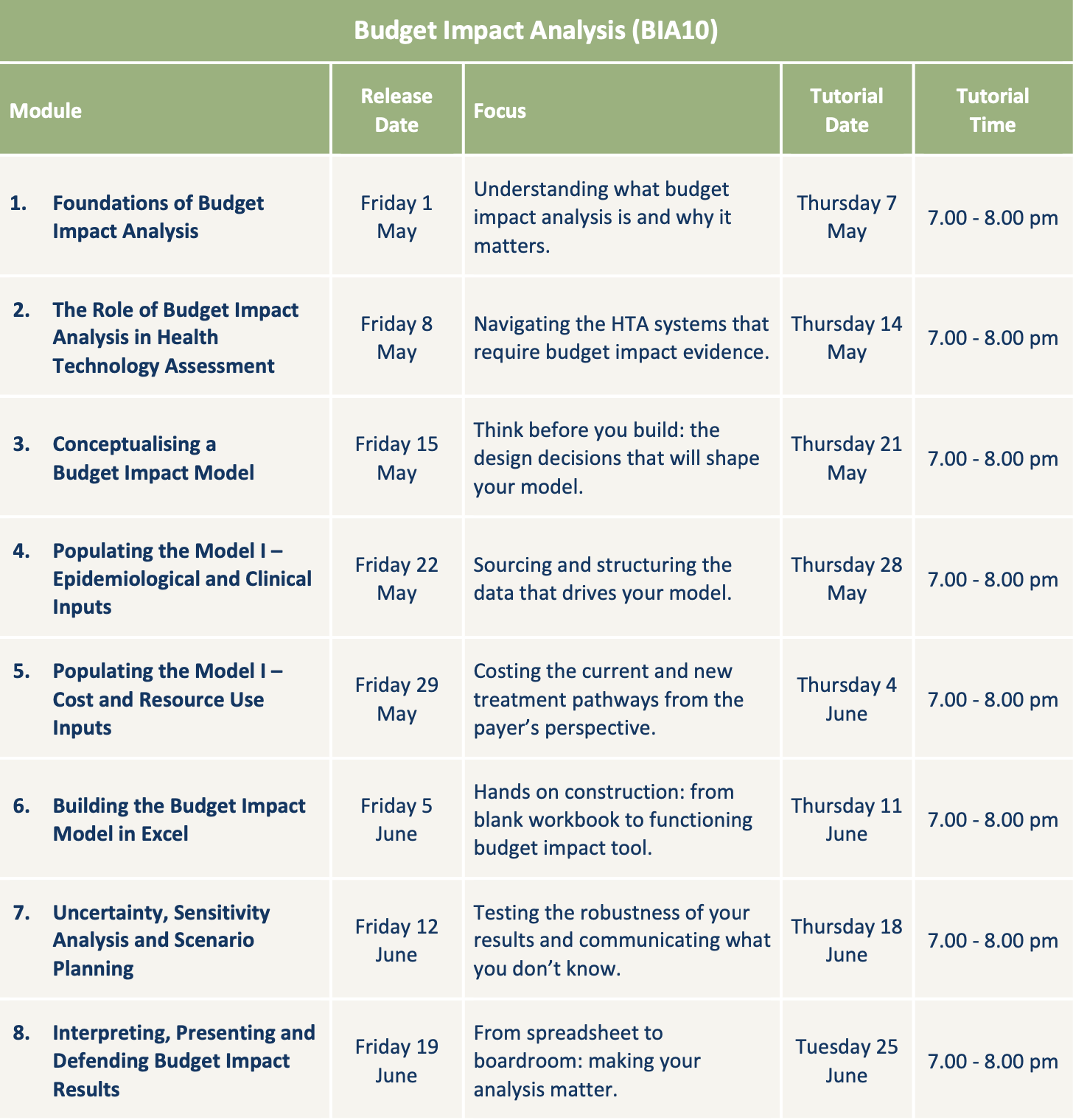
This course is broken down into eight manageable weekly modules:
This course should take approximately 6 – 8 hours per week. You can expect to devote about 2 – 3 hours per week to self-paced learning, about 2 hours per week preparing for and participating in the virtual tutorial and 2 – 3 hours per week applying your knowledge through learning activities and mini-projects. Every tutorial is recorded so you can rewatch it at any time.
This course is designed for health economists, market access professionals, HTA analysts, medical affairs specialists and consultants working in the pharmaceutical, medical device and diagnostics industries who need to produce or critically appraise budget impact analyses. It is equally relevant for NHS managers and commissioners evaluating new technologies, academic researchers entering the field of health economics and clinicians increasingly expected to engage with economic evidence. No prior health economic modelling experience is required.
Upon successful completion of the course you’ll receive an:
Ready to start? Just click the ‘Register now’ button at the top of this page or use the ‘Ask us a question’ button if you’d like to talk to one of our course facilitators. The fee for this course is £995 per person. If you’d like to pay in instalments you can arrange this by contacting us at: [email protected].
All registrations are subject to our terms and conditions which are available here. By registering for an IHLM course you are accepting these terms and conditions and agreeing to be bound by them.
This module introduces the core concepts of budget impact analysis (BIA) – establishing how it differs from other forms of economic evaluation and why healthcare payers increasingly require it.
This module maps the global health technology assessment (HTA) landscape and examines the specific role BIA plays in each system’s decision-making framework.
This module works through the key structural choices that determine whether a budget impact model is fit for purpose, culminating in the development of a model concept document.
This module addresses the critical challenge of estimating the size of an eligible population and incorporating the clinical inputs that determine resource use differences between comparators.
This module focuses on identifying, sourcing and structuring the cost inputs that allow a model to estimate the financial consequences of adopting a health intervention.
This is the core practical module in which learners build a fully functional budget impact model in Excel, step by step, following a structured workbook architecture.
This module teaches learners how to characterise, quantify, and communicate the uncertainty inherent in every budget impact model.
The final module bridges the gap between technical modelling and real-world decision-making, equipping learners to present and defend their findings in any payer context.



Healthcare Leadership

Our flagship course for high-potential healthcare leaders: built around the core strategic management disciplines and designed to prepare you for more senior roles and greater responsibilities.
Patient Experience

A comprehensive course for progressive healthcare providers and professionals who want to design and deliver more person-centred, compassionate and responsive care.
HEOR Strategy

This course enables you to plan, design and manage the clinical and economic evidence needed to support market access, reimbursement and health technology assessment.
Health Technology Assessment

This course will enable you and your healthcare organisation to achieve operational excellence by improving capacity, productivity and patient flow at every stage of care.
Value Communication

Discover how to set up effective error reporting systems, lead investigations into adverse incidents, implement successful patient safety improvement projects and design safer systems of care.
Value Communication

This course will enable you to master the concepts, methods and tools you need to lead successful quality improvement projects or become a quality improvement specialist.
Health Economic Modelling

A practical, Excel-based course on how to design, build and present budget impact models for health technology assessments, business cases and value propositions.
Health Economic Modelling

This hands-on course shows you how to build, interpret and present cost-effectiveness and cost-utility models that measure the value of health interventions and guide healthcare decision-making.
Evidence Review and Synthesis

Discover how to plan, commission and evaluate rapid evidence reviews that generate accelerated, evidence-based insights in response to time-sensitive demands.
Real-World Evidence

A practical course that equips you to design, conduct, analyse and appraise observational studies that generate credible evidence for HTA bodies and payers.
Evidence Review and Synthesis

A practical course that will enable you to compile, appraise and summarise existing research using the “gold standard” in evidence-based decision-making.
HEOR Strategy

Discover how artificial intelligence is reshaping health economics and outcomes research — and what it means for the professionals who commission and undertake this work.
Value Communication

Discover how to transform clinical, economic and outcomes evidence into a compelling value story that convinces decision-makers and accelerates market access.
Health Technology Assessment

This case study-based course introduces you to the fundamentals of health technology assessment and how to get submissions right first time.
February 13, 2026
Introducing yourself properly is surely a basic necessity if we’re to be a respectful and trusted caregiver?
May 9, 2025
Can glove change help reduce the costs and improve the outcomes of caesarean sections – enabling obstetric teams to deliver more value-based care?
Course starts: 18 March 2026
Location: Online
Course starts: 27 March 2026
Location: Online

