Value Communication
Every day, millions of people around the world are treated safety and effectively. But advances in medical technology and knowledge are making healthcare more complex and, unfortunately, things can and do go wrong no matter how dedicated and professional healthcare staff are. Making care safer and reducing avoidable harm therefore continue to be fundamental goals for everyone who manages or leads the delivery of patient care.
This course provides comprehensive coverage of all of the knowledge and skills required by today’s patient safety and risk management professionals. It explores how, in healthcare, fallible human beings and complex systems interact to create a challenging safety environment. The course also shows you, in considerable depth, how to set up effective error reporting systems and lead investigations into adverse incidents in order to learn from harm and reduce the likelihood of recurrence. In addition to guiding you through each stage of a patient safety improvement project the course will enable you to develop your impact as an agent of change capable of convincing physicians and other clinical staff to collaborate with you to design safer systems of care and develop a culture of safety.
Delivered via IHLM’s online learning platform and through live interactive virtual tutorials, you will become part of a global community learning how to transform patient safety together.
The course content has been carefully benchmarked against the English National Health Service’s Patient Safety Incident Response Framework (PSIRF), the Patient Safety Movement’s Patient safety curriculum and the Institute for Healthcare Improvement’s Certified Professional in Patient Safety (CPSS) examination to ensure that it is fully up-to-date with current thinking and best practice. Upon completion of the course you will be able to:
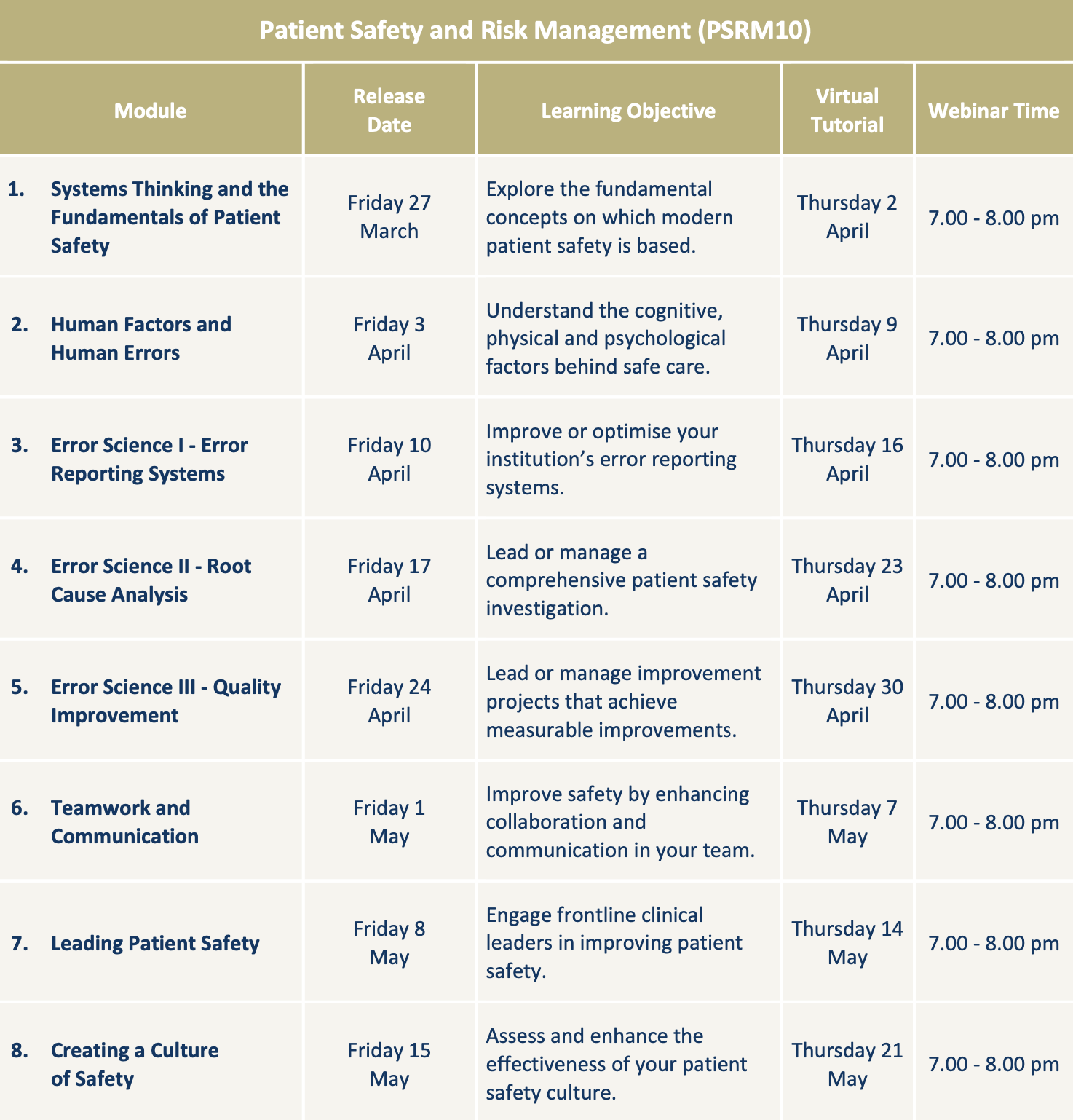
This course is broken down into eight manageable weekly modules:
This course should take approximately 4 – 6 hours per week. You can expect to devote about 1 – 2 hours per week to self-paced learning, 1 – 2 hours per week preparing for and participating in the webinar and 1 – 2 hours per week applying your knowledge through learning activities and mini-projects. Every webinar is recorded so you can rewatch it at any time.
This course will benefit anyone who has an interest in, or responsibility for, the safety of patients and the management of clinical risk. This can include patient safety officers and specialists; clinical leaders such as physicians, nurses and allied healthcare professionals and staff in administrative or managerial roles who want to improve their understanding of this most fundamental body of knowledge.
The course is also ideal for both established and emerging patient safety leaders who want to improve their skills and knowledge, maximise their professional impact and advance their career.
Upon successful completion of the course you’ll receive an:
Ready to start? Just click the ‘Register now’ button at the top of this page or use the ‘Ask us a question’ button if you’d like to talk to one of our course facilitators. The fee for this course is £995 per person. If you’d like to pay in instalments you can arrange this by contacting us at: [email protected].
We provide discounts to organisations registering 3 or more staff in the course and can also provide a customised in-house version tailored to your organisation’s specific needs.
All registrations are subject to our terms and conditions which are available here. By registering for an IHLM course you are accepting these terms and conditions and agreeing to be bound by them.
In our first module we will introduce the course by reviewing the nature and frequency of medical errors and adverse incidents as well as the three fundamental concepts upon which the contemporary study of patient safety is based: complexity, integration and high reliability. The topics covered in this module include:
In Module 2 we will explore the cognitive, physical and psychological factors that affect how human beings and health systems interact and discover how we can design safer health systems. The topics covered in this module include:
This is the first of three modules that will take an in-depth look at how errors should be reported, investigated and responded to. We begin by considering the importance of having systems capable of capturing safety issues and concerns. The topics covered in this module include:
In Module 5 we review, in detail, the skills and knowledge needed to manage and lead a comprehensive patient safety investigation using Root Cause Analysis (RCA). The topics covered in this module include:
In the third of our error science modules we explore how to undertake an improvement project and how to measure its impact on patient safety. The topics covered in this module include:
Effective teamwork and communication both play a critical role in keeping patients safe. In this module we discover why they are important and how we can improve them. The topics covered in this module include:
In Module 8 we consider the critical role the patient safety leader or specialist plays in a healthcare organisation and the skills, knowledge and behaviours that make a high-performing patient safety leader. The topics covered in this module include:
A culture in which every caregiver values patients and their safety is the aspiration of all progressive healthcare organisations. In this module we discover why this aspiration can, however, be elusive and consider what it takes to create and sustain a genuinely ‘just culture’ that facilitates exceptional safety standards. The topics covered in this module include:



Patient Experience

A comprehensive course for progressive healthcare providers and professionals who want to design and deliver more person-centred, compassionate and responsive care.
Value Communication

Discover how to set up effective error reporting systems, lead investigations into adverse incidents, implement successful patient safety improvement projects and design safer systems of care.
Healthcare Leadership
Our flagship course for high-potential healthcare leaders: built around the core strategic management disciplines and designed to prepare you for more senior roles and greater responsibilities.
Value Communication

This course will enable you to master the concepts, methods and tools you need to lead successful quality improvement projects or become a quality improvement specialist.
Health Economic Modelling
A practical, Excel-based course on how to design, build and present budget impact models for health technology assessments, business cases and value propositions.
Health Economic Modelling

This hands-on course shows you how to build, interpret and present cost-effectiveness and cost-utility models that measure the value of health interventions and guide healthcare decision-making.
Evidence Review and Synthesis

Discover how to plan, commission and evaluate rapid evidence reviews that generate accelerated, evidence-based insights in response to time-sensitive demands.
Real-World Evidence

A practical course that equips you to design, conduct, analyse and appraise observational studies that generate credible evidence for HTA bodies and payers.
Evidence Review and Synthesis

A practical course that will enable you to compile, appraise and summarise existing research using the “gold standard” in evidence-based decision-making.
HEOR Strategy

Discover how artificial intelligence is reshaping health economics and outcomes research — and what it means for the professionals who commission and undertake this work.
Value Communication

Discover how to transform clinical, economic and outcomes evidence into a compelling value story that convinces decision-makers and accelerates market access.
Health Technology Assessment

This case study-based course introduces you to the fundamentals of health technology assessment and how to get submissions right first time.
HEOR Strategy

This course enables you to plan, design and manage the clinical and economic evidence needed to support market access, reimbursement and health technology assessment.
Health Technology Assessment

This course will enable you and your healthcare organisation to achieve operational excellence by improving capacity, productivity and patient flow at every stage of care.
February 13, 2026
Introducing yourself properly is surely a basic necessity if we’re to be a respectful and trusted caregiver?
May 9, 2025
Can glove change help reduce the costs and improve the outcomes of caesarean sections – enabling obstetric teams to deliver more value-based care?
Course starts: 26 June 2026
Location: Online
Course starts: 04 September 2026
Location: Online