Health Economic Modelling
Cost-effectiveness analysis (CEA) is the analytical framework that health systems use to decide whether a new medicine, device or diagnostic is worth paying for. It is the primary evidence requirement of England’s National Institute for Health and Care Excellence (NICE) and many other health technology assessment (HTA) bodies across Europe. Its influence on reimbursement, formulary and procurement decisions continues to grow. For any professional working in health economics, market access or medical affairs, the ability to design, build and critically appraise a cost-effectiveness model is no longer optional — it is a core professional competency.
This course provides a comprehensive, practical introduction to CEA as it is conducted in real-world HTA settings. Spanning both CEA and its dominant modern form — cost-utility analysis (CUA) — the course takes participants from first principles through to a fully functional economic model built using Microsoft Excel. It will equip you to generate outputs such as incremental cost-effectiveness ratios (ICERs), characterise uncertainty through probabilistic sensitivity analysis and present findings that will withstand the scrutiny of HTA reviewers and payer audiences. With NICE submissions, global dossiers and health service procurement decisions all depending on credible cost-effectiveness evidence the demand for professionals who genuinely understand this methodology has never been greater.
Delivered via IHLM’s online learning platform and through live interactive virtual tutorials this course will enable you to measure value and guide healthcare decision-making.
On completion of this course you’ll be able to:
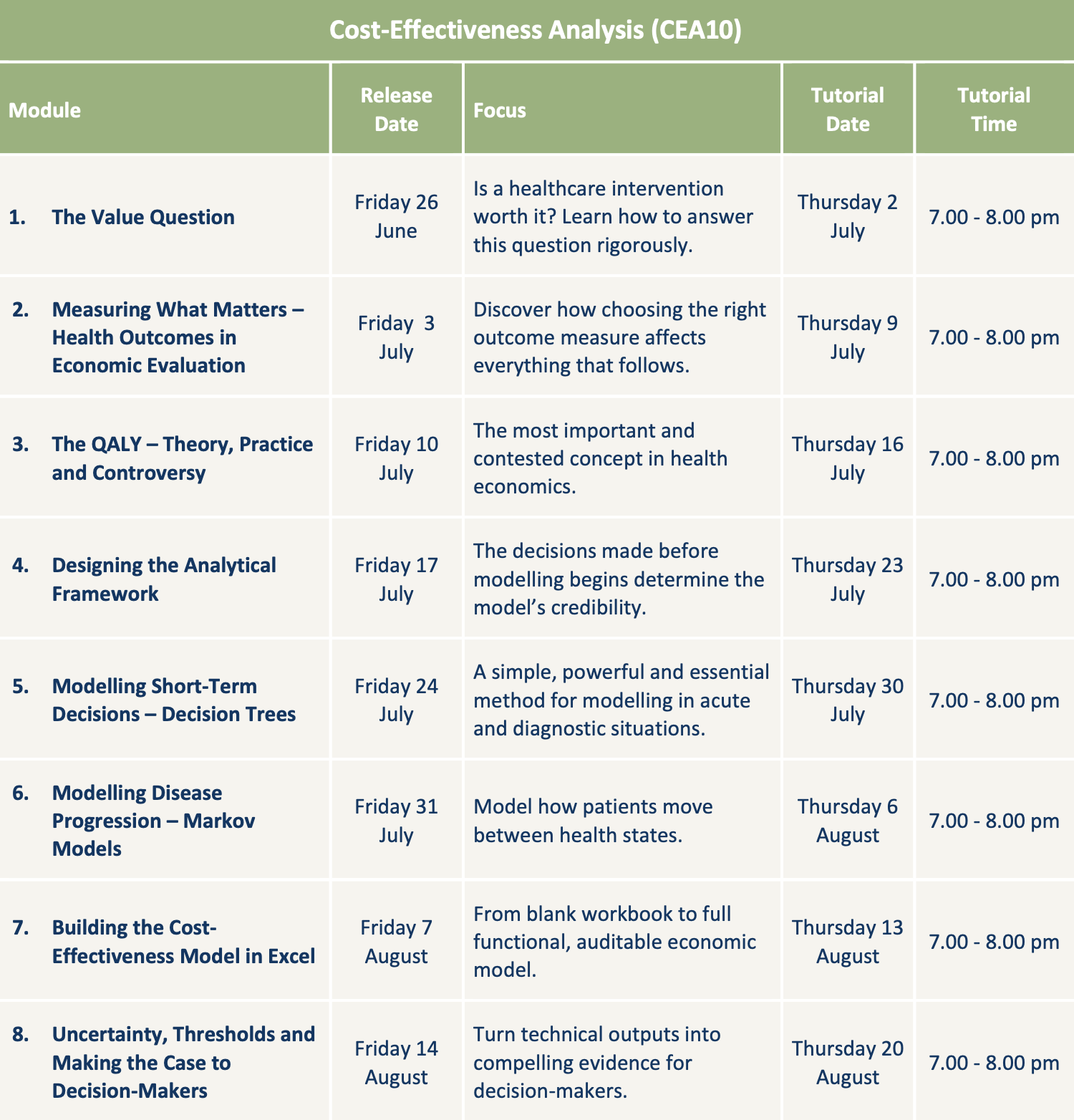
This course is broken down into eight manageable weekly modules:
This course should take approximately 6 – 8 hours per week. You can expect to devote about 2 – 3 hours per week to self-paced learning, about 2 hours per week preparing for and participating in the virtual tutorial and 2 – 3 hours per week applying your knowledge through learning activities and mini-projects. Every tutorial is recorded so you can rewatch it at any time.
This course is designed for health economists, market access professionals, HTA analysts and medical affairs specialists working in the pharmaceutical, medical device and diagnostics industries. It is equally relevant for NHS managers and commissioners evaluating new technologies and academic researchers entering the field of health economics. No prior experience of health economic modelling is required, though participants will benefit from a working knowledge of Microsoft Excel.
Upon successful completion of the course you’ll receive an:
Ready to start? Just click the ‘Register now’ button at the top of this page or use the ‘Ask us a question’ button if you’d like to talk to one of our course facilitators. The fee for this course is £995 per person. If you’d like to pay in instalments you can arrange this by contacting us at: [email protected].
All registrations are subject to our terms and conditions which are available here. By registering for an IHLM course you are accepting these terms and conditions and agreeing to be bound by them.
Economic evaluation in healthcare begins with a deceptively simple question: is this intervention worth it? Our first module examines what that question really means, why it is harder to answer than it appears and how cost-effectiveness analysis (CEA) provides a structured framework for doing so.
Before a health economic model can be built the analyst must decide what to measure. This module explores the range of outcome measures used in CEA, from natural clinical units to generic preference-based measures, and explains why the choice of outcome metric shapes everything that follows.
The QALY is the most important and most contested concept in HTA. This module gives learners the thorough grounding in QALY methodology that is essential for building credible submissions and engaging critically with HTA decisions.
Economic models are only as credible as the decisions made before the first formula is entered. This module works through the structural choices that determine whether a submission will be considered methodologically sound by HTA reviewers.
This module introduces decision trees as the appropriate structure for interventions with short time horizons or acute decision problems.
Markov models are the most widely used structure in HTA and building one well is the core practical competency this course delivers. This module takes learners from the conceptual framework through to a fully populated model using Microsoft Excel.
This is the hands-on core of the course. Working from the Markov structure introduced in Module 6, participants will build a complete, auditable cost-effectiveness model using Microsoft Excel — generating an ICER, a cost-effectiveness plane and a cost-effectiveness acceptability curve.
The final module moves from technical construction to the analytical and communication skills needed to present cost-effectiveness evidence persuasively to HTA bodies, payers and clinical stakeholders — and to defend it under scrutiny.



Healthcare Leadership

Our flagship course for high-potential healthcare leaders: built around the core strategic management disciplines and designed to prepare you for more senior roles and greater responsibilities.
Patient Experience

A comprehensive course for progressive healthcare providers and professionals who want to design and deliver more person-centred, compassionate and responsive care.
HEOR Strategy

This course enables you to plan, design and manage the clinical and economic evidence needed to support market access, reimbursement and health technology assessment.
Health Technology Assessment

This course will enable you and your healthcare organisation to achieve operational excellence by improving capacity, productivity and patient flow at every stage of care.
Value Communication

Discover how to set up effective error reporting systems, lead investigations into adverse incidents, implement successful patient safety improvement projects and design safer systems of care.
Value Communication

This course will enable you to master the concepts, methods and tools you need to lead successful quality improvement projects or become a quality improvement specialist.
Health Economic Modelling

A practical, Excel-based course on how to design, build and present budget impact models for health technology assessments, business cases and value propositions.
Health Economic Modelling

This hands-on course shows you how to build, interpret and present cost-effectiveness and cost-utility models that measure the value of health interventions and guide healthcare decision-making.
Evidence Review and Synthesis

Discover how to plan, commission and evaluate rapid evidence reviews that generate accelerated, evidence-based insights in response to time-sensitive demands.
Real-World Evidence

A practical course that equips you to design, conduct, analyse and appraise observational studies that generate credible evidence for HTA bodies and payers.
Evidence Review and Synthesis

A practical course that will enable you to compile, appraise and summarise existing research using the “gold standard” in evidence-based decision-making.
HEOR Strategy

Discover how artificial intelligence is reshaping health economics and outcomes research — and what it means for the professionals who commission and undertake this work.
Value Communication

Discover how to transform clinical, economic and outcomes evidence into a compelling value story that convinces decision-makers and accelerates market access.
Health Technology Assessment

This case study-based course introduces you to the fundamentals of health technology assessment and how to get submissions right first time.
February 13, 2026
Introducing yourself properly is surely a basic necessity if we’re to be a respectful and trusted caregiver?
May 9, 2025
Can glove change help reduce the costs and improve the outcomes of caesarean sections – enabling obstetric teams to deliver more value-based care?
Course starts: 18 March 2026
Location: Online
Course starts: 27 March 2026
Location: Online

