Health Technology Assessment
One of the most fundamental requirements of high-quality patient care is that it is timely and efficient. Unnecessary waits and sometimes harmful delays must be avoided, as must the wasting of valuable resources such as equipment, consumables and the time and energy of caregivers themselves. However, healthcare services face ongoing difficulties in providing sufficient capacity to deliver the right care, in the right place, at the right time. And as the global Covid-19 pandemic has vividly illustrated, the consequences of getting capacity decisions wrong are almost always serious and sometimes fatal.
This highly relevant course enables clinicians and managers to overcome capacity and productivity challenges using practical tools that can be put to work immediately to analyse the current operational performance of a healthcare facility or service; measure the gap between actual and desired performance and then make radical improvements. The course considers all four ‘levers’ of healthcare operations excellence – purchasing and supply, process technology, capacity and improvement – but places a particular emphasis on aligning capacity and demand in order to enhance patient flow – ie, the ability to treat patients quickly and efficiently, with minimal waits or delays, as they move through the stages of their care.
Delivered via IHLM’s online learning platform, this course will enable you to become part of a global community learning how to transform patient flow together.
On completion of this course you’ll be able to:
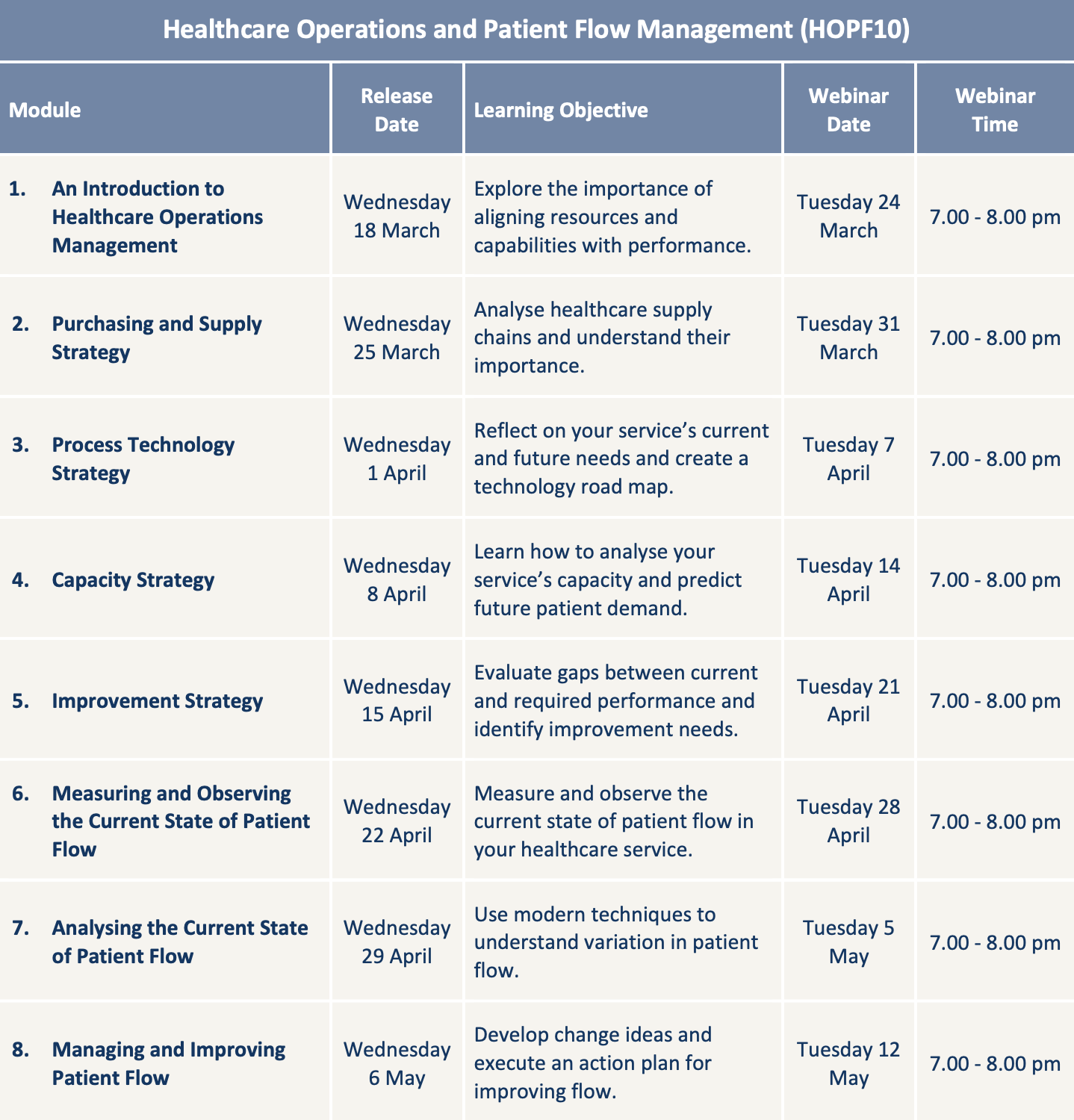
This course is broken down into eight modules:
This course should take approximately 2 – 4 hours per week. You can expect to devote about 1 – 2 hours per week to self-paced learning and 1 – 2 hours per week applying your knowledge through learning activities and mini-projects.
This course will benefit anyone, whether they have a clinical or an administrative background, who manages or leads the day-to-day operations of a healthcare service or who plays a role in delivering operational excellence or optimising patient flow.
Upon successful completion of the course you’ll receive an:
Ready to start? Just click the ‘Register now’ button at the top of this page or use the ‘Ask us a question’ button if you’d like to talk to one of our course facilitators. The fee for this course is £995 per person. If you’d like to pay in instalments you can arrange this by contacting us at: [email protected].
We provide discounts to organisations registering 3 or more staff in the course and can also provide a customised in-house version tailored to your organisation’s specific needs.
All registrations are subject to our terms and conditions which are available here. By registering for an IHLM course you are accepting these terms and conditions and agreeing to be bound by them.
In our opening module we explore what healthcare operations management is and why the performance it results in can make or break a healthcare organisation or service. The topics covered in this module include:
No healthcare service works in isolation: it is always dependent on a network of suppliers for everything from drugs and consumables to IT systems and diagnostic equipment. In our second module we discover how successful healthcare managers make important purchasing and supply decisions. The topics covered in this module include:
Technology has far too profound an impact on the delivery of healthcare services for decisions about its use to be left solely to technical specialists. In Module 3 we explore the role a healthcare manager should take in deciding what technologies to invest in and when to use them. The topics covered in this module include:
As the global Covid-19 pandemic has vividly illustrated, the fundamental challenge for every healthcare service is to provide sufficient capacity to meet patient demand. The consequences of getting capacity decisions wrong are almost always serious and sometimes fatal. In this module we therefore consider:
Improvement lies at the heart of healthcare operations. Healthcare services that habitually use improvement programmes to make care more timely, more efficient and more cost effective will achieve far better performance than those that don’t. In this module we therefore explore:
In Module 4, on capacity strategy, we discovered how important it is to be able to forecast patient demand and compare it with our service’s capacity. Now, in Module 6, we take a much deeper dive into this subject by learning techniques that can be used to measure and observe the current state of patient flow in our healthcare service. The topics covered in this module include:
Having measured and observed patient flow using techniques such as process mapping, Module 7 focuses on how to analyse and interpret this information. The topics covered in this module include:
In the last two modules we learned how to measure, observe and analyse the current state of patient flow. Now comes the hard part – managing and improving that flow. In this module we therefore consider:



Healthcare Leadership

Our flagship course for high-potential healthcare leaders: built around the core strategic management disciplines and designed to prepare you for more senior roles and greater responsibilities.
Patient Experience

A comprehensive course for progressive healthcare providers and professionals who want to design and deliver more person-centred, compassionate and responsive care.
HEOR Strategy

This course enables you to plan, design and manage the clinical and economic evidence needed to support market access, reimbursement and health technology assessment.
Health Technology Assessment

This course will enable you and your healthcare organisation to achieve operational excellence by improving capacity, productivity and patient flow at every stage of care.
Value Communication

Discover how to set up effective error reporting systems, lead investigations into adverse incidents, implement successful patient safety improvement projects and design safer systems of care.
Value Communication

This course will enable you to master the concepts, methods and tools you need to lead successful quality improvement projects or become a quality improvement specialist.
Health Economic Modelling

A practical, Excel-based course on how to design, build and present budget impact models for health technology assessments, business cases and value propositions.
Health Economic Modelling

This hands-on course shows you how to build, interpret and present cost-effectiveness and cost-utility models that measure the value of health interventions and guide healthcare decision-making.
Evidence Review and Synthesis

Discover how to plan, commission and evaluate rapid evidence reviews that generate accelerated, evidence-based insights in response to time-sensitive demands.
Real-World Evidence

A practical course that equips you to design, conduct, analyse and appraise observational studies that generate credible evidence for HTA bodies and payers.
Evidence Review and Synthesis

A practical course that will enable you to compile, appraise and summarise existing research using the “gold standard” in evidence-based decision-making.
HEOR Strategy

Discover how artificial intelligence is reshaping health economics and outcomes research — and what it means for the professionals who commission and undertake this work.
Value Communication

Discover how to transform clinical, economic and outcomes evidence into a compelling value story that convinces decision-makers and accelerates market access.
Health Technology Assessment

This case study-based course introduces you to the fundamentals of health technology assessment and how to get submissions right first time.
February 13, 2026
Introducing yourself properly is surely a basic necessity if we’re to be a respectful and trusted caregiver?
May 9, 2025
Can glove change help reduce the costs and improve the outcomes of caesarean sections – enabling obstetric teams to deliver more value-based care?
Course starts: 18 March 2026
Location: Online
Course starts: 27 March 2026
Location: Online

