Health Technology Assessment
Health technology assessment (HTA) is the process by which healthcare systems determine whether a new technology — a pharmaceutical, a medical device, diagnostic test or digital health solution — represents sufficient value to justify adoption and funding.
For anyone working in market access, medical affairs or HEOR, understanding how HTA works is not optional: it is the framework within which virtually every reimbursement decision is made. Yet it is often encountered piecemeal without the broader understanding of why these systems exist, how they differ and what they have in common. The result is an industry full of professionals who can recite the cost-per-QALY threshold but cannot explain why different agencies reach different conclusions about the same technology, or what distinguishes a submission that succeeds from one that fails.
This course provides that broader understanding. It covers the principles and architecture of HTA, the major approaches used across different jurisdictions and the practical realities of how committees evaluate evidence and reach decisions. Rather than attempting to teach the mechanics of preparing a submission — which varies by agency and changes frequently — the course focuses on the strategic and conceptual foundations that remain stable: what HTA bodies are trying to achieve, how they weigh clinical and economic evidence, where the common failure points lie and what the most instructive case studies in HTA history reveal about what it takes to secure a positive recommendation. Participants will leave with a clear mental map of the global HTA landscape and the judgment to navigate it effectively.
Delivered via IHLM’s online learning platform and through live interactive virtual tutorials you will become part of a global community learning how to inform and influence healthcare decision-makers.
On completion of this course you’ll be able to:
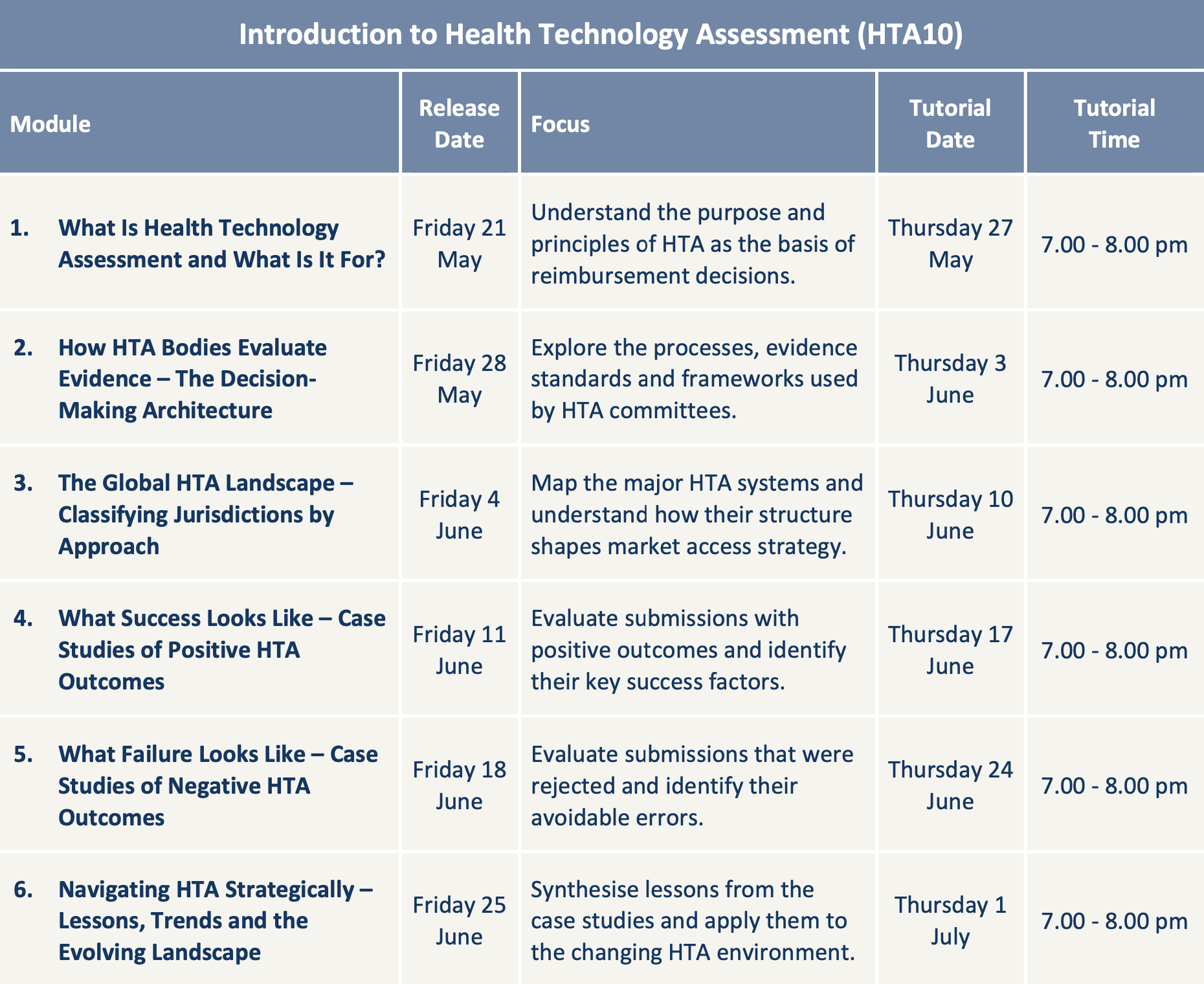
This course is broken down into eight manageable weekly modules:
This course should take approximately 6 – 8 hours per week. You can expect to devote about 2 – 3 hours per week to self-paced learning, about 2 hours per week preparing for and participating in the virtual tutorial and 2 – 3 hours per week applying your knowledge through learning activities and mini-projects. Every tutorial is recorded so you can rewatch it at any time.
This course is designed for market access managers, medical affairs professionals and HEOR managers who interact with HTA decision-makers or whose work feeds into HTA submissions. It is equally relevant for professionals new to HTA who need a structured introduction to the field and for experienced practitioners who understand individual agency processes but lack a broader comparative perspective. The course does not assume prior technical knowledge of health economics or modelling, making it accessible to professionals from clinical, regulatory, commercial and policy backgrounds who need to understand how HTA shapes the market access environment in which they operate.
Upon successful completion of the course you’ll receive an:
Ready to start? Just click the ‘Register now’ button at the top of this page or use the ‘Ask us a question’ button if you’d like to talk to one of our course facilitators. The fee for this course is £995 per person. If you’d like to pay in instalments you can arrange this by contacting us at: [email protected].
All registrations are subject to our terms and conditions which are available here. By registering for an IHLM course you are accepting these terms and conditions and agreeing to be bound by them.
Healthcare systems face a fundamental tension: the technologies available to them are expanding faster than the budgets available to pay for them. Health technology assessment (HTA) exists to resolve that tension — to provide a structured, evidence-based process for deciding which technologies represent sufficient value to justify public funding. This module introduces the core principles of HTA and explains why it has become the dominant framework for reimbursement decision-making worldwide.
HTA is not a single methodology — it is a family of approaches united by common principles but differing substantially in how evidence is evaluated, how committees deliberate and how decisions are framed. This module examines the architecture of HTA decision-making, covering the key stages from evidence submission through committee deliberation to final recommendation.
Rather than cataloguing every HTA agency in every country, this module provides participants with a practical framework for classifying jurisdictions by approach — enabling them to understand a new market’s HTA system quickly by identifying which archetype it most closely resembles.
The most effective way to understand what HTA bodies value is to study the submissions they have approved. This module examines a selection of case studies — drawn from across therapy areas and jurisdictions — in which manufacturers secured positive recommendations, and identifies the common factors that contributed to success.
HTA failures are at least as instructive as successes — and many of the most consequential failures were avoidable. This module examines case studies in which submissions received negative or restricted recommendations, and draws out the recurring patterns that participants can learn to recognise and prevent.
This module brings together the conceptual foundations and case study lessons from the preceding modules and applies them to the HTA landscape as it is evolving today. It equips participants to think strategically about how HTA will shape market access over the coming years and what this means for their own evidence planning and submission strategies.



Healthcare Leadership

Our flagship course for high-potential healthcare leaders: built around the core strategic management disciplines and designed to prepare you for more senior roles and greater responsibilities.
Patient Experience

A comprehensive course for progressive healthcare providers and professionals who want to design and deliver more person-centred, compassionate and responsive care.
HEOR Strategy

This course enables you to plan, design and manage the clinical and economic evidence needed to support market access, reimbursement and health technology assessment.
Health Technology Assessment

This course will enable you and your healthcare organisation to achieve operational excellence by improving capacity, productivity and patient flow at every stage of care.
Value Communication

Discover how to set up effective error reporting systems, lead investigations into adverse incidents, implement successful patient safety improvement projects and design safer systems of care.
Value Communication

This course will enable you to master the concepts, methods and tools you need to lead successful quality improvement projects or become a quality improvement specialist.
Health Economic Modelling

A practical, Excel-based course on how to design, build and present budget impact models for health technology assessments, business cases and value propositions.
Health Economic Modelling

This hands-on course shows you how to build, interpret and present cost-effectiveness and cost-utility models that measure the value of health interventions and guide healthcare decision-making.
Evidence Review and Synthesis

Discover how to plan, commission and evaluate rapid evidence reviews that generate accelerated, evidence-based insights in response to time-sensitive demands.
Real-World Evidence

A practical course that equips you to design, conduct, analyse and appraise observational studies that generate credible evidence for HTA bodies and payers.
Evidence Review and Synthesis

A practical course that will enable you to compile, appraise and summarise existing research using the “gold standard” in evidence-based decision-making.
HEOR Strategy

Discover how artificial intelligence is reshaping health economics and outcomes research — and what it means for the professionals who commission and undertake this work.
Value Communication

Discover how to transform clinical, economic and outcomes evidence into a compelling value story that convinces decision-makers and accelerates market access.
Health Technology Assessment

This case study-based course introduces you to the fundamentals of health technology assessment and how to get submissions right first time.
February 13, 2026
Introducing yourself properly is surely a basic necessity if we’re to be a respectful and trusted caregiver?
May 9, 2025
Can glove change help reduce the costs and improve the outcomes of caesarean sections – enabling obstetric teams to deliver more value-based care?
Course starts: 18 March 2026
Location: Online
Course starts: 27 March 2026
Location: Online

