Value Communication
Market access success depends not only on the quality of the underlying evidence but on how effectively that evidence is communicated. This is the central challenge of value communication: translating clinical, economic and humanistic data into a narrative that addresses what payers, procurement committees and health technology assessment (HTA) bodies actually need to hear. Too often, compelling evidence fails to secure the intended outcome — not because it is weak but because it is presented in technical language, structured around the wrong endpoints or disconnected from the audience’s decision criteria. The difference between a successful and an unsuccessful market access outcome frequently comes down to whether the value story was tailored to the needs of the people making the decision.
Value communication is a distinct discipline that sits at the intersection of evidence, strategy and persuasion. It encompasses the full range of deliverables through which a product’s value is conveyed to decision-makers — from global value dossiers to payer slide decks, procurement presentations and objection-handling frameworks. With HTA and procurement processes becoming increasingly formalised across all life science sectors, and with payer audiences growing more sophisticated in their requirements, the ability to communicate value clearly, credibly and in the right format has become a core competency for anyone working in market access, medical affairs or HEOR. This course teaches participants how to do it.
Delivered via IHLM’s online learning platform and through live interactive Zoom webinars you will become part of a global community learning how to tell compelling value stories.
On completion of this course you’ll be able to:
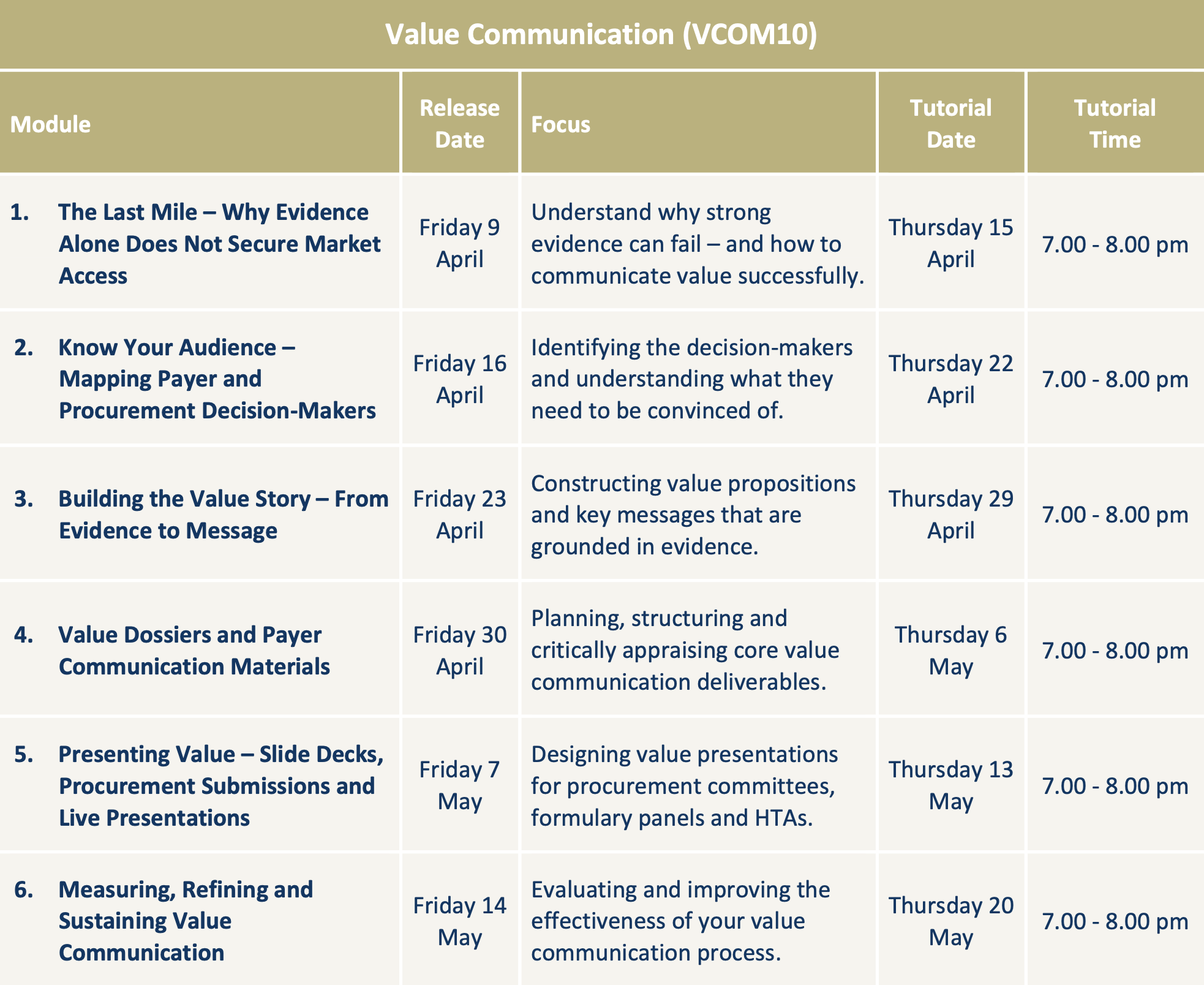
This course is broken down into six manageable weekly modules:
This course should take approximately 6 – 8 hours per week. You can expect to devote about 2 – 3 hours per week to self-paced learning, about 2 hours per week preparing for and participating in the virtual tutorial and 2 – 3 hours per week applying your knowledge through learning activities and mini-projects. Every tutorial is recorded so you can rewatch it at any time.
This course is designed for market access managers, medical affairs professionals and HEOR managers responsible for communicating the value of health technologies to payers and procurement decision-makers. It is particularly relevant for professionals who commission or oversee the development of value dossiers, payer presentations and reimbursement submissions, and who need to ensure that the evidence generated by their organisations is translated into materials that are clear, credible and aligned with what decision-makers actually require. No prior experience with value dossier development is assumed, though participants will benefit from a working familiarity with the types of clinical and economic evidence that underpin value claims.
Upon successful completion of the course you’ll receive an:
Ready to start? Just click the ‘Register now’ button at the top of this page or use the ‘Ask us a question’ button if you’d like to talk to one of our course facilitators. The fee for this course is £745 per person. If you’d like to pay in instalments you can arrange this by contacting us at: [email protected].
All registrations are subject to our terms and conditions which are available here. By registering for an IHLM course you are accepting these terms and conditions and agreeing to be bound by them.
Life science companies invest heavily in generating clinical and economic evidence, yet market access outcomes frequently disappoint — not because the evidence is weak but because it is poorly communicated. This module introduces the concept of value communication as a distinct discipline and examines what separates effective payer engagement from technical data presentation.
A value message that resonates with a health technology appraisal committee will not necessarily land with a hospital procurement panel, a German sickness fund or a US pharmacy and therapeutics committee. This module teaches participants to map the decision landscape systematically, identifying the relevant audiences, their decision criteria and the evidence formats they expect to receive.
The transition from a body of evidence to a coherent value story is where most organisations struggle. This module covers the structured process of distilling clinical, economic and humanistic evidence into a value proposition and a set of key messages that can be adapted for different audiences and communication formats.
Value dossiers are the primary vehicle for communicating a product’s clinical, economic and humanistic value to payers and HTA bodies. This module examines the major dossier formats, their structural requirements and the principles that distinguish a compelling dossier from a mere data dump.
Written dossiers are only part of the value communication landscape. Increasingly, market access outcomes depend on live presentations to procurement committees, formulary panels and HTA advisory groups — settings where the ability to present evidence clearly, handle questions confidently and adapt messaging in real time is critical.
Value communication is not a one-off deliverable — it is an ongoing process of testing, learning and refining. This module covers how to evaluate whether value messages are landing, how to use payer feedback to improve materials and how to build organisational capability in value communication over time.



Healthcare Leadership

Our flagship course for high-potential healthcare leaders: built around the core strategic management disciplines and designed to prepare you for more senior roles and greater responsibilities.
Patient Experience

A comprehensive course for progressive healthcare providers and professionals who want to design and deliver more person-centred, compassionate and responsive care.
HEOR Strategy

This course enables you to plan, design and manage the clinical and economic evidence needed to support market access, reimbursement and health technology assessment.
Health Technology Assessment

This course will enable you and your healthcare organisation to achieve operational excellence by improving capacity, productivity and patient flow at every stage of care.
Value Communication

Discover how to set up effective error reporting systems, lead investigations into adverse incidents, implement successful patient safety improvement projects and design safer systems of care.
Value Communication

This course will enable you to master the concepts, methods and tools you need to lead successful quality improvement projects or become a quality improvement specialist.
Health Economic Modelling

A practical, Excel-based course on how to design, build and present budget impact models for health technology assessments, business cases and value propositions.
Health Economic Modelling

This hands-on course shows you how to build, interpret and present cost-effectiveness and cost-utility models that measure the value of health interventions and guide healthcare decision-making.
Evidence Review and Synthesis

Discover how to plan, commission and evaluate rapid evidence reviews that generate accelerated, evidence-based insights in response to time-sensitive demands.
Real-World Evidence

A practical course that equips you to design, conduct, analyse and appraise observational studies that generate credible evidence for HTA bodies and payers.
Evidence Review and Synthesis

A practical course that will enable you to compile, appraise and summarise existing research using the “gold standard” in evidence-based decision-making.
HEOR Strategy

Discover how artificial intelligence is reshaping health economics and outcomes research — and what it means for the professionals who commission and undertake this work.
Value Communication

Discover how to transform clinical, economic and outcomes evidence into a compelling value story that convinces decision-makers and accelerates market access.
Health Technology Assessment

This case study-based course introduces you to the fundamentals of health technology assessment and how to get submissions right first time.
February 13, 2026
Introducing yourself properly is surely a basic necessity if we’re to be a respectful and trusted caregiver?
May 9, 2025
Can glove change help reduce the costs and improve the outcomes of caesarean sections – enabling obstetric teams to deliver more value-based care?
Course starts: 18 March 2026
Location: Online
Course starts: 27 March 2026
Location: Online

